
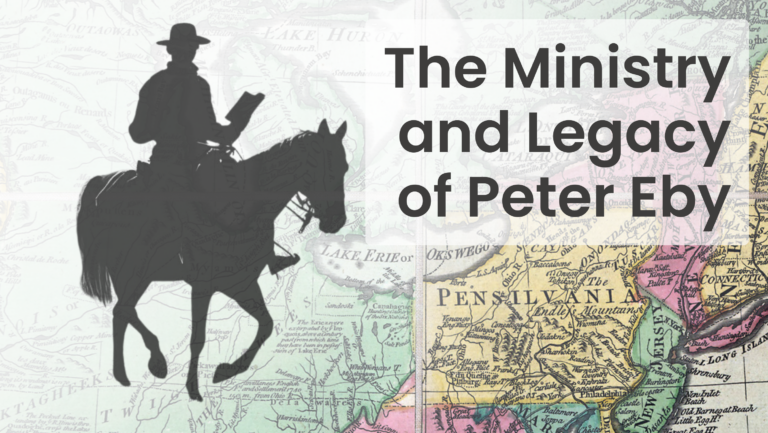
Peter Eby – The Great Swiss-American Anabaptist Elder of Pequea
In the fall of 1765, a son was born into the Eby home along the Hammer Creek in Lancaster County, Pennsylvania. Peter was the third child of Anabaptist deacon Christian and Catharine (Bricker) Eby. He grew up among a community of Swiss immigrants, many of which remembered coming to America in the previous decades.
Peter’s great-grandfather was Theodorus Eby, a minister and son of an Anabaptist elder from the Zurich area, and his grand-father was deacon Christian Eby. Peter never met either of them, but he surely heard stories of how they came to America from Switzerland 50 years before he was born. He likely heard of their pilgrimage through the Palatinate (in Germany) and how they finally ended up as millers on the Mill Creek in Lancaster County. Peter himself grew up during the American revolution, experiencing war and hardship, and no-doubt hearing of Swiss Anabaptist immigrants in Lancaster County who were fined, had their properties seized, or otherwise persecuted. Some of them were incarcerated an hour or two south (by horseback) in Lancaster, Pennsylvania. Growing up with this context and background had a profound impact on young Peter.
However, as often happens with young men, this all faded in the light of a burgeoning friendship with a young Swiss neighbor girl. Elizabeth was an Anabaptist from the Brubacher family which had immigrated from Heimiswil near Bern, Switzerland. During the “off season” of 1791 on the second Monday of February they were united in marriage at the Hammer Creek meeting house by Elder Christian Burkholder.
Christian was an Overseer among the Swiss Anabaptists of northern Lancaster County from Hammer Creek to Weberthal (Weaverland), and Lichty’s. In the first three generations of Swiss Anabaptists in America, “Elders” were not dedicated to specific congregations or assemblies, but rather served areas or regions, much like the “city-wide churches” of the New Testament. Neither were they defined by conference or denomination. That was about to change significantly. In 1800 the first new denomination (in America) was co-founded by former Anabaptist Martin Boehm following his expulsion from the Swiss Anabaptists of Lancaster because of his promotion of the American Revolution.
Following their marriage, Peter and Elizabeth continued to live in the “Hammer Creek Area” for about 15 years during which time they had eight children, four boys and four girls. During this period, in the year 1800 they began purchasing land in Salisbury Township near present day Gap, Pennsylvania. Around the same time, Peter was nominated as a candidate to become a minister but not ordained. In 1805 the Eby family moved to their new farm a mile west of Gap, establishing a homestead near what would later famously be called “Eby’s Curve”, on the Pennsylvania railroad. In Salisbury they had 3 more children.
While Peter’s home area of “Hammer Creek” had a dedicated meeting house, the region to which they moved had no such provision. Meetings were held in homes and schools. However, within a year of their move the first meetinghouse in the area was completed around 1806, 8 miles west in the town of Strasburg. It was also known as the Pequea or Paradise Meetinghouse (Pequea district). Additional meeting houses in the area were not dedicated until one at Hershey’s in 1837 and one at Old Road (White Horse) in 1841. About a year after the move, Peter was chosen by lot and ordained minister (German “diener” – servant) on October 12, 1806, at the age of 41 years old. He was ordained by Elder Christian Burkholder who had married Peter and Elizabeth 15 years prior. He was ordained at the newly constructed meeting house in Strasburg as an assistant for Henry Metzler of the Strasburg congregation, who “had heretofore supplied most of the spiritual needs of this section of the valley.”
Following in the heritage of preceding generations of Eby Anabaptist leaders, Peter began ministering, preaching, and serving the church in ways that would grow to further maturity throughout his life and no doubt prepared the way to his future ordination as Elder/Bishop. Contemporaries described his preaching as “eloquent” and “soul-stirring;” he was likened by some to Thaddeus Stevens, the fiery abolitionist orator. Peter blended doctrinal rigor with pastoral warmth, emphasizing sound Anabaptist doctrines. He was described as possessing a “clear native mind” and “natural oratory,” unburdened by scholarly pretensions yet commanding deference in spiritual and temporal affairs. His preaching captivated audiences and over time his fame drew overflowing crowds, filling homes to capacity wherever he spoke.
Peter began regular and extensive travels, mostly by horseback, becoming a Swiss Anabaptist “circuit rider”. In 1809 Peter, along with other brethren, traveled to Ebytown (later Berlin, now Kitchener) in Ontario Canada by horseback to ordain as minister his younger brother Benjamin, who had emigrated there earlier. They also visited many communities along the way. As a minister, and later as Elder, Peter traveled and ministered in many other communities in Lancaster and neighboring counties. He was usually accompanied by a number of brethren on these long horseback trips. In 1812, Peter and his associates again made the trip to Ontario to attend the ordination of his brother Benjamin as Bishop by Jacob Hershey.
When Peter and Elizabeth moved to Gap, there were no “resident elders” in the area as John Herr of Strasburg (the last one to live in the section that would become known as the Pequea district), had died in 1797. Oversight was more or less provided by Christian Burkholder and other “traveling” Elders. The Proverb “A man’s gift makes room for him and brings him before great men” – Proverbs 18-16, became true of Peter. Following the death of Elders Christian Burkholder and Jacob Hershey (who died earlier in 1815), Peter was ordained Elder/Bishop by his cousin Bishop Henry Eby of Hammer Creek on May 22, 1815, at the Pequea Meeting House. This was at least partly because of his effective labors, ministry, and leadership in the Pequea area.
Following this ordination at age 50 as Overseer, Peter expanded his traveling ministry and would regularly visit the scattered settlements of Lebanon, Dauphin, Cumberland, Snyder, Juniata, Mifflin, Huntingdon, Franklin, Adams, and York Counties of PA, as well as Washington County, MD and as far west as Winchester, VA. He would usually make a 4-6 week trip after spring planting. At times other bishops would travel with him or otherwise assist in this work. He would also occasionally visit the churches of Swiss-German Anabaptists in the Franconia area and in many places in Chester County.
Following the 1818 ordination of Christian Burkholder of Conestoga Valley (a different Christian Burkholder then the previous one who married the Eby’s and ordained him as minister) Peter and Christian became “fast friends”. In fact, “Burkholder’s district was largely instrumental in lifting the large mortgage from the Canadian Colony…” (which was a special interest of Peter’s).
During this season a number of changes were solidified among the Anabaptist Swiss Brethren. They began to be referred to and refer to themselves almost exclusively as Mennonites, ironically directly contradicting the teaching of Menno Simons himself who boldly declared “We are not of those who call ourselves by men’s names!” They migrated from meeting in homes to using “meeting houses” which would ultimately morph into “churches.” The term “Bishop” almost totally replaced the word “Elder” (German – Aeltester). This was not only a change of terms, slowly but surely, especially after Peter’s death, their roles migrated from uncoercive, advisory and declarative, to much more focused on “enforcement” of agreed standards. “Districts” were solidified, named, and defined, with Bishops being progressively more matched to specific districts. And while the Elders among the Swiss Anabaptist immigrants always worked together and shared with each other, as well as meeting regularly for fellowship, support, and decisions, those meetings and the above clarified “districts” began to result in a much more organized and structured “conference”. This structure and tradition crystalized and evolved, so as will be reviewed later, when at the end of Peter’s life he went about to ordain his replacement, the only acceptable way for that generation to process this decision or action was through the authority of the conference, which was very different than the ways of the Swiss Brethren in generations prior. Peter served on the Lancaster Bishop Board, a regional council for ordinations, disputes, and mutual aid, and by 1831 he had become moderator of the “Lancaster Mennonite Conference” — one of the earliest organized bodies for inter-congregational coordination among the churches now known as Mennonites.
This role amplified Peter’s influence, and he assisted the conference with adopting formal positions like the 1632 Dordrecht Confession. During Peter’s service as Bishop, “All of the churches in his district increased in numbers, and the churches of the entire conference were placed on a firmer basis than ever before.” He was appreciated for his kindness and fondness and soon became known as “The great Mennonite Bishop of Pequea”.
Another enduring legacy of his ministry among the Swiss Anabaptists, now called Mennonites, of Lancaster County and surrounding areas, was his leadership in navigating crises they were confronted with. This began before his ordination as bishop. The first one was the 1812 schism birthing the Reformed Mennonite Church under John Herr, a former Pequea minister. Herr decried a perceived laxity in discipline, dress, and meetings, advocating stricter separation, including shunning intermarried members. As bishop, Peter opposed this “Herrite” faction, defending the existing unity of the churches and the corporate balance of grace and accountability. The split halved some congregations, but Peter’s oratory and mediation retained the majority, reinforcing congregational polity over hierarchical rigidity. He mediated disputes per Matthew 18:15–20, prioritizing restoration through stepwise admonition—private counsel, witnesses, and communal confrontation—over punitive exclusion. Also in 1812, Peter shepherded “his flock” through relating to “The War of 1812”. With British American hostilities raging near Pennsylvania borders, Mennonites again faced conscription pressures. Peter guided his churches and people through exemptions, petitions, fines, and communal support for afflicted families, echoing Revolutionary-era strategies. His leadership preserved unity, averting the “pacifism-induced fractures” seen elsewhere.
Peter’s contributions extended to education and community welfare. Though illiterate in formal terms, he supported rudimentary schools, catechesis, and German language preservation against Anglicizing forces. As a deacon’s son, he championed alms for the poor, embodying diaconal service. His farm at Eby’s Curve became a waystation for traveling preachers, fostering networks that linked Pequea to emerging Midwest settlements. Unlike his brother Benjamin, who authored catechisms and histories, Peter left no writings—his legacy was oral and relational, etched in the memories of congregants.
Towards the end of his life in 1840 when Peter was 75 years old, as he began to feel the weight of time pressing heavily on his declining body strength, Peter became much concerned for the welfare and prosperity of the Mennonite churches in Lancaster and beyond and for the perpetuation of the Gospel of Christ in the earth upon his departure. He prayed mightily to God, asking Him to point out the one who should lead His people as successor in the work of the Church, the one who would be pleasing to Him who knows and rules all things well. God revealed to the venerable bishop that Christian Herr, a faithful minister of the Gospel and a tried-and-true servant of Jesus Christ living ten miles away in Lime Valley, was His chosen vessel to carry on the work. Brother Herr was pleased by the report that Peter would visit him soon but was much surprised when the man of God revealed his mission to him. He shared how he would be called (through the church) to be an assistant bishop and then after his death or disability, he should have the entire oversight of the work. Peter shared that he felt that God had revealed this to him by his Holy Spirit and that he fully believed it. However, brother Herr was not so easily convinced and humbly refused to accept the charge in such a manner. However, when it was taken to “spring conference”, and when all the counsel of the leaders and the voice of the churches alike was taken, the only candidate proposed or confirmed was indeed, Christian Herr. Accordingly, Christian was ordained as the assistant bishop that summer and continued in that capacity for nearly 3 years until Peter’s passing at age 77 on April 6, 1843.
Having served as an ordained leader for nearly four decades, Peter was interred in the Hershey Mennonite Church Cemetery—a site he helped consecrate. His wife Elizabeth survived him by five years, joining him in 1848. His passing marked the end of an era, but his imprint endured. Wherever he had served, churches were solidly anchored, vibrant, full, and overflowing. His tenure was defined by stewardship during crises and a growing commitment to confessional standards. John F. Funk, a 19th-century Mennonite publisher, praised Eby’s teachings as “sound Mennonite doctrines,” free from the revivalist excesses encroaching from broader Protestantism.
In closing, while it would be nice to finish on a positive note, unfortunately as is often the case in human history, there were a number of “unintended consequences” that resulted from Peter’s ministry and leadership. His son-in-law, the husband of his youngest daughter, helped lead the Stauffer Mennonite split of 1845, proclaiming that they were preserving the church and vision that Peter had championed against trending changes. Also, while Peter never actually supported Sunday schools and other forms that violated “old-order Mennonite norms”, his support of vibrancy and education helped lay the groundwork that ultimately resulted in the Old-Order split of 1890. His organizational and collaborative work also likely significantly helped prepare the way for the establishment of the Mennonite General Conference, seen by many as the harbinger of liberalism and progressivism.
In spite of some these “arguably negative results”, Peter left an undeniable positive legacy. His promotion of peacemaking, goodwill and networking left a relationally stronger church network and community behind. His spiritual fervor impacted the lives of many and no-doubt reversed spiritual decline in the regions where he labored. Seen in the love, adoration, and honor of those he ministered to, his influence lived on long after he was gone. His example of the untiring work and labor of good leadership shapes and inspires burgeoning leaders who take the time to study the cost, cause, and effect of the same today. And lastly, as evidenced by the way he chose his successor, his personal prayer life and walk with God was a foundational practice that shaped all his life and should inspire us today.
Sources:
- “Mennonites of Lancaster Conference” – M.G. Weaver (1931)
- Global Anabaptist Mennonite Encyclopedia Online (GAMEO)
- “Eby Family” entry.
- “Otterbein, William”
- “Boehm, Boehm, Martin”
- Lancaster County land records:
- Warwick and Elizabeth Township deeds
- Lancaster County Deed Book A, p. 124 (Jacob Boehm land warrant, 1718) Lancaster County Deed Records (1805 transaction, recorded 1806).
- Peter assessed in Salisbury Twp. every year 1805–1843 — no multi-week absences except 1809/1812. County Deed Book X, p. 517 (1800 land purchase in Salisbury)
- A Biographical History of the Eby Family by Ezra E. Eby (1889)
- Mennonite Vital Records (Lancaster Mennonite Historical Society)
- Hammer Creek Meetinghouse records; deacon lists.
- Hammer Creek Mennonite Church Marriage Register (original ledger, 1780–1820). Bishop Christian Burkholder’s pastoral log.
- Pequea congregation minutes (1805–1843).
- Lancaster Mennonite Historical Society:
- A Biographical History of the Boehm Family
- Peter Eby Family Bible – notes relocation year.
- Pequea Mennonite Church Ordination Record “Peter Eby of Salisbury Twp. ordained to the ministry by Bishop Christian Burkholder, Oct. 12, 1806.”
- Pequea Mennonite Church Ordination Ledger “Peter Eby ordained bishop by lot, May 22, 1815, by Bishop Henry Eby.”
- Pequea Council Book, 1798–1810 (nomination entry)
- Hammer Creek Membership List, 1800 (Peter listed as “visiting” Pequea)
- Bishopric Districts Map, 1818
- Stauffer Papers, Mennonites of Lancaster Conference pp. 210–215, Pequea Church Minutes 1844–45)
- The Eby Report (genealogical newsletter), confirming his role in the Hammer Creek congregation.
- Swiss Anabaptist Genealogical Association:
- Bern Canton persecution logs (1684, 1692).
- Richard W. Davis, Emigrants, Refugees and Prisoners (Vol. 2), p. 97 – on Jacob and Theodorus Eby’s roles.
- History of the Church of the United Brethren in Christ by A. W. Drury (1890)
- United Brethren archives (Huntington University)
- Swiss Anabaptist Genealogical records (Richard W. Davis, Emigrants, Refugees and Prisoners, Vol. 1)
- Bishop Henry Eby’s Diary (1815 entry): “Ordained Peter Eby to the bishopric at Paradise meetinghouse.”
- Dictionary of Canadian Biography (Vol. 8, 1985): “Ordained first as minister (27 Nov. 1809) and then as bishop (11 Oct. 1812) at ceremonies presided over by his brother Peter, a bishop from Pennsylvania.”
- Waterloo Mennonite Church records (e.g., History of the Eby Family, 1889 extract): Confirm dates and Peter’s presence.
- Waterloo Mennonite Church Ordination Book (1812 entry):
- Peter’s own letters (to son John in Canada, 1820s): “I have been to your uncle’s country twice…” The letters are stored at the Mennonite Heritage Center Archives in Harleysville, PA.
- Waterloo Archives: Debt Relief Correspondence, 1821
- Stauffer Mennonite Discipline Book (1846)



Leave a Reply